 Rusuban
Rules
A locked list that always asks, your own rules on top, and a tester that shows what would happen before you rely on it.
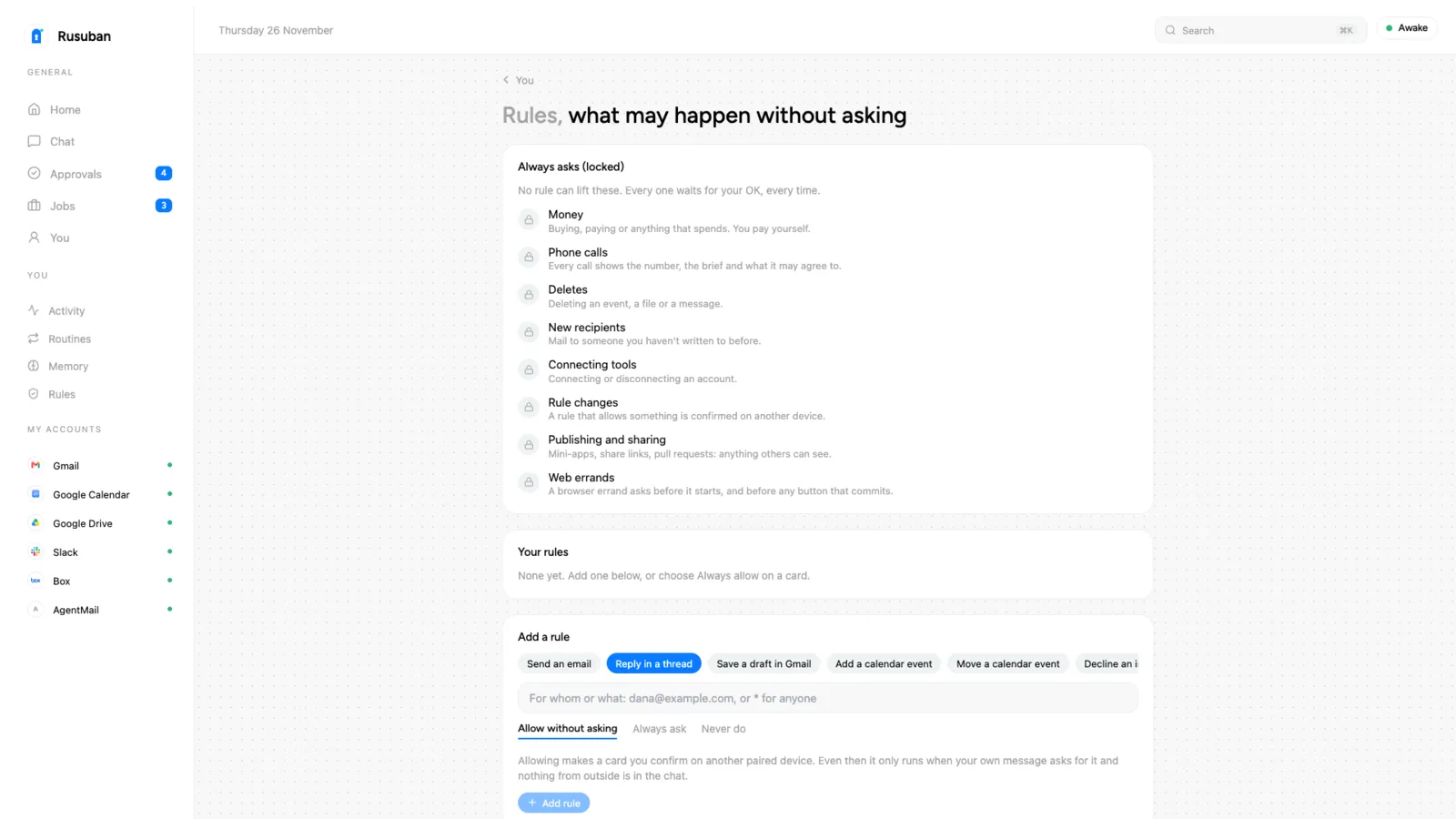
Always asks
No rule can lift these. Each one waits for your OK, every time:
| Locked | What it means in practice |
|---|---|
| Money | No tool pays and the agent never types card details. Shopping stops at checkout; in other errands a buy or pay button is its own card. |
| Phone calls | Every call shows the number, the opening line and what it may agree to. |
| Deletes | Deleting a calendar event. |
| New recipients | An allowed email still asks if a recipient isn't in your sent mail. |
| Connecting tools | Accounts are connected only by you, in the installer. |
| Rule changes | A rule that always allows something is confirmed on another paired device. |
| Publishing and sharing | Mini-apps, share links, pull requests: anything others can see. |
| Web errands | An errand asks before it starts, and before any button that commits. |
Your rules
Add a rule: pick the kind of action (any of the card kinds), say for whom or what (an address, or * for anyone), and choose. Any kind can be set to Always ask or Never do; only kinds off the locked list can be allowed.
| Effect | Result |
|---|---|
| Allow without asking | Makes a card you approve on a different paired device, so a stolen session can't add rules. Once confirmed, the action can run without a card, but only when your own latest message asks for it, nothing from outside was read in that chat (for messages with free text), every recipient is already in your sent mail, and Jev is at least 70% sure your words asked for exactly this. Anything short of that still asks, with the reason on the card. |
| Always ask | Never runs without a card, even if another rule would allow it. |
| Never do | Refused outright. |
When rules overlap, the strictest wins. You can also allow something for one conversation from its card (Approve, and allow in this chat); that takes effect at once, on the device that chose it, and runs under the same checks.
An action that ran under a rule is recorded as an automatic decision with the rule's original approval as its reason, and goes through the same outbox, undo window and checks as any other.
What would happen
The tester at the bottom takes a kind, a recipient and the text you'd write, plus whether an email or a web page was read in that chat, and answers Runs without asking, Asks you first or Never happens, with the reasons. It uses the same gate the agent uses.
Approvals and safety
The model can only propose. Every outward action is a card with the exact payload, checked again before it goes, with Edit, Undo and an honest "May have run".
Brief and Needs you
Gmail, Calendar, Drive, Slack, Box and its own inbox, sorted by Jev into needs you and can wait, with a reason for each and a morning brief that admits what it couldn't check.